8 Things to Cut From Your Wedding Speech Right Now
The quickest way to make a wedding speech better? Knowing what to leave out. Here are eight things to cut before you pick up the mic.
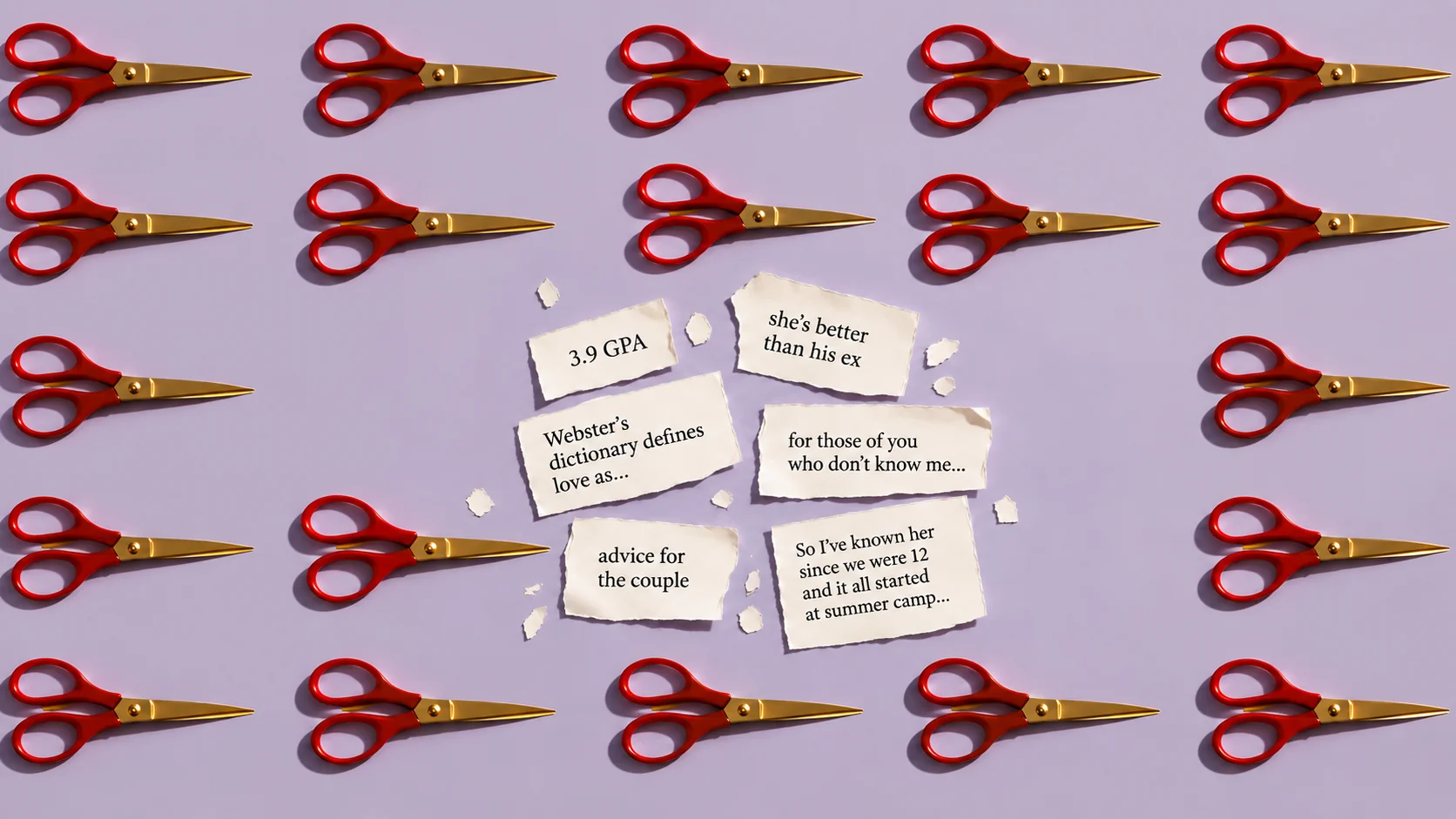
Most bad wedding speeches are just one edit away from being good. Because more often than not, it’s not what the speaker left out that made everyone cringe—it’s what they decided to keep in.
Every childhood accomplishment. Every college story. Every inside joke. Every person the groom dated before meeting the bride. The anecdote that requires six minutes of context but, trust me, is hilarious once you get there.
A wedding speech shouldn’t be a detailed accounting of everything you’ve ever experienced together. The best ones make a few smart choices—and make those choices count.
So before you hit print on that final draft, make sure these eight things didn’t make the cut.
1. The résumé
We don’t need the GPA. Or every extracurricular. Or a career chronology that takes us from first internship to latest promotion.
A list of accomplishments shows us what someone has done. A good story shows us who they are.
Instead of telling us that your sister was valedictorian, captain of the soccer team, president of three clubs, and eventually became a surgeon, look for the story underneath all of that. Maybe she was the ten-year-old who practiced free throws until the streetlights came on. Maybe she spent every dollar of her birthday money on science books. Maybe she once made a color-coded study guide for a test she wasn’t even taking.
That’s where the person lives. And, more often than not, where you’ll find the theme of your speech.
2. The story that takes three minutes to explain
You know the one.
First, we need to understand who Jeff is. Jeff dated Lauren, who lived with Katie, who was in your sorority—but a different pledge class—and this all matters because of what happened sophomore year at a bar that closed in 2019.
If we need a family tree and a map to understand the punchline, it’s probably not the story to share.
Wedding speeches have limited real estate. Every second you spend explaining the setup is a second you’re not using to make us laugh, feel something, or understand the person you’re celebrating more deeply.
The best stories announce themselves quickly.
3. The inside jokes
Inside jokes are great for group chats. They are less great when 147 wedding guests are wondering why four friends at Table 6 are crying laughing about something called “The Pretzel Incident.”
Speeches should be inclusive.
That doesn’t mean every story has to be universally relatable. In fact, the specificity of a private memory is often what makes it great. But the audience should be able to understand why it matters.
If the story reveals that your best friend can make any disaster fun, tell it. If its only function is reminding the two of you of a joke you’ve been making since eighth grade, save it for later.
4. “They might kill me for saying this…”
No. We will die on this hill: toast, not roast.
A wedding speech is not your opportunity to finally tell 150 guests about the groom’s disastrous dating history, the bride’s most embarrassing college night, or that one story you’ve been explicitly forbidden from repeating.
A little teasing can be funny. Affectionate specificity can be even funnier. But embarrassment itself is not a punchline.
A useful test: Is the joke funny because it reveals something lovable about them—or because you know they’ll be mortified? If it’s the second one, cut it.
5. Advice for the couple
It’s a toast, not a sermon.
If you have a genuine and specific hope for the couple that maps back to the rest of your speech, wonderful. Tell them you hope they keep booking the flight, hosting the dinners, dancing in the kitchen.
But advice simply because wedding speeches are apparently where we all become relationship experts? You can skip it.
You don’t need to explain the secret to a successful marriage, particularly if no one asked you to. Speak from what you actually know about this couple instead.
6. The ex
The ex’s name should never be uttered on the wedding day.
Even when the story feels harmless. Even when everyone is friendly now. Even when the comparison ends very favorably for the person standing at the altar. There is always a better way to make your point.
You can show us that your friend changed when they met their partner without providing a historical survey of everyone who came before them.
7. “For those of you who don’t know me…”
You do need to establish who you are and why you’re standing there—but you don’t need to open with a line everyone in the room has heard before. Try getting right to the relationship instead.
“I’m Emma’s younger sister, which means I’ve spent 29 years stealing her clothes, copying her decisions, and pretending neither was happening.”
“I met Daniel freshman year, when he walked into our dorm room carrying a guitar, six baseball hats, and apparently enough confidence for both of us.”
Now we know who you are and we’ve started learning something about the person you’re there to celebrate.
8. Anything that doesn’t earn its place
This is the harder cut.
Sometimes a story is funny. Sometimes you love it. Sometimes it’s one of your favorite memories. And sometimes it still doesn’t belong in the speech.
Once you know what you really want to say about this person or couple, every story has a job: it should help you say it.
Maybe you’re showing us that your brother has always gone all in—and finally found someone willing to jump with him. Maybe your daughter has spent her entire life making everyone feel like they belong, and now she’s found the place where she does.
The stories that prove that idea stay. The ones that don’t? Even the good ones? Cut them.
Quick FAQs
What should you not say in a wedding speech?
Skip anything that embarrasses the couple, references an ex, requires a ton of backstory, or only makes sense to a handful of guests. A great wedding speech should make the couple feel seen—not exposed.
Is it okay to roast the bride or groom in a wedding speech?
A little teasing can work if it’s affectionate and reveals something lovable about them. But the goal is a toast, not a roast. If the joke is funny because they’ll be mortified, cut it.
Should you mention an ex in a wedding speech?
No. Even if the comparison is flattering to the person they married, there’s almost always a better way to make the point without bringing an ex into the room.
What should I cut if my wedding speech is too long?
Start with anything that requires a lot of setup, repeats a point you’ve already made, or tells us what someone accomplished rather than who they are. Keep the stories that reveal something specific about the person or couple and support the larger idea of your speech.
Do these wedding speech rules apply to maid of honor, best man, and parent speeches?
Yes. Whether you’re giving a maid of honor speech, best man speech, mother of the bride speech, father of the bride speech, or another wedding toast, the same principle applies: choose the stories that reveal something meaningful about the person or couple, and cut the ones that don’t.
Ready to write yours?
Speech Tank turns your memories into a polished wedding speech in minutes.